

HARDVANES® EKVAC EVO+
Technology for dry-running vacuum pumps and compressors.
Vanes inGRAPHITE.At their best.
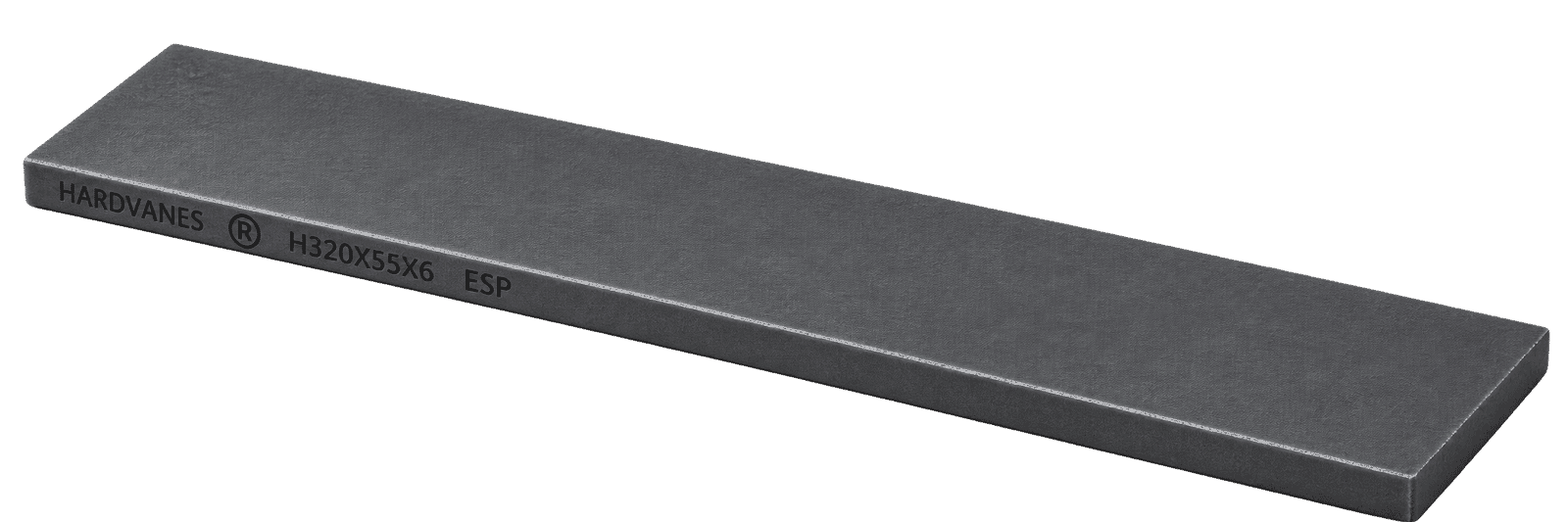
Self-lubricating graphite.
Specified for dry-running vacuum pumps.
THE ORIGIN.Of precision.
Self-lubricating graphite vanes. HARDVANES® EKVAC EVO+ technology for dry operation.
We manufacture graphite vanes for dry-running vacuum pumps and rotary compressors using German-origin material machined in Spain. Each part combines three inseparable decisions: the correct material, the geometry of the part and its surface finish.
A vacuum pump vane slides within the rotor and helps separate the pumping chambers. Choosing a replacement therefore requires more than its dimensions. The application, fit, bevel orientation and actual operating conditions all matter.
EKVAC EVO+ is our range of carbon graphite vanes for these requirements. We examine the pump reference and the part’s characteristics before confirming compatibility.
In catalogues and maintenance enquiries, these replacements are also described as carbon vanes, carbon blades or graphite blades. The commercial name does not identify the carbon graphite grade: always check the material, dimensions and part number for a vacuum pump.
View carbon graphite properties ↓GLIDE.Self-lubricating graphite.
Graphite provides the vane’s self-lubrication.
Graphite facilitates sliding at the contact surfaces. In a pump designed for dry operation, it allows the pumping chamber to operate without an oil supply.
EKVAC EVO+ technology starts with application-specific carbon graphite. Contact behaviour, mechanical strength and dimensional stability are considered together. It is not selected as a universal graphite for every function.
Sliding behaviour
Tribological behaviour describes how the material and the surface interact during motion.
Strength
The vane bears loads. Flexural strength helps characterise the material but does not, by itself, determine service life.
Stability
Thermal expansion is considered alongside the machine’s clearances and temperature.
Specification
Grade, geometry and actual service conditions are checked together before selecting the replacement.
GRAPHITE.Self-lubricating.
The lubrication is in the vane itself.
In a vacuum pump designed for dry operation, the carbon graphite vanes provide self-lubrication at the cylinder contact. The pumping chamber operates without an oil supply.

One vane.
Two functions.
The vanes separate the pumping chambers and their material enables sliding. Graphite is a functional part of the replacement, not merely its raw material.
Continuous contact.
Specific material.
During rotation, the vanes slide in the rotor slots and maintain contact with the cylinder. The carbon graphite formulation must meet the demands of friction, load and temperature.
Running dry.
With self-lubrication.
HARDVANES® EKVAC EVO+ is intended for dry-running vacuum pumps and compressors. Selection combines the graphite grade, geometry and finish required by each part number.
View material properties ↗The motion that creates vacuum.
The rotor turns off-centre within the cylinder. The vanes slide in their slots and form chambers. Air enters when the volume connected to the inlet increases.
Rotation carries the air from the inlet towards the discharge area. Vane contact and assembly clearances help separate the chambers.
The chamber volume decreases during rotation. Air is compressed and discharged through the outlet according to the pump’s design and operating conditions.
The vane is part of a system: filters, sealing, cooling and rotor condition also influence the available vacuum.
EVERY MICRON.Every surface.
A sound specification becomes a useful part when the geometry is also correct.
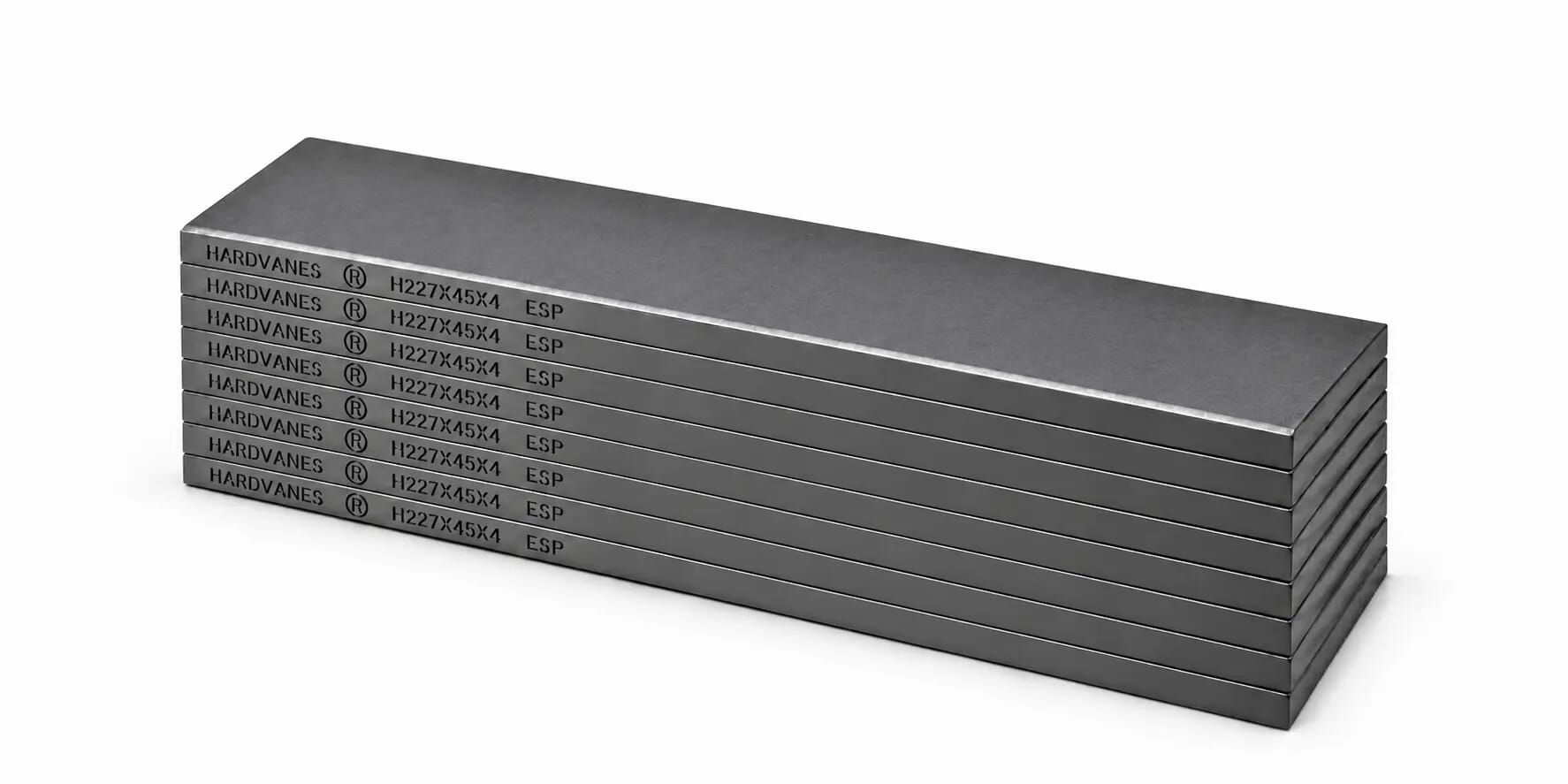
Graphite machining and milling
Length, height and thickness relate to the rotor slot and vane travel. The sample or drawing is checked against the equipment reference.
Flatness and parallelism
The faces must meet the dimensional specification. Precision is assessed through measurements and tolerances; appearance does not replace that check.
Bevels and finish
Bevel positions, edge profiles and grooves follow the original design. Polishing, including a mirror-like finish where appropriate, serves the function of the part.
THE SHAPE.Technology too.
Compact vanes, long formats and complete sets. Each part serves an application.
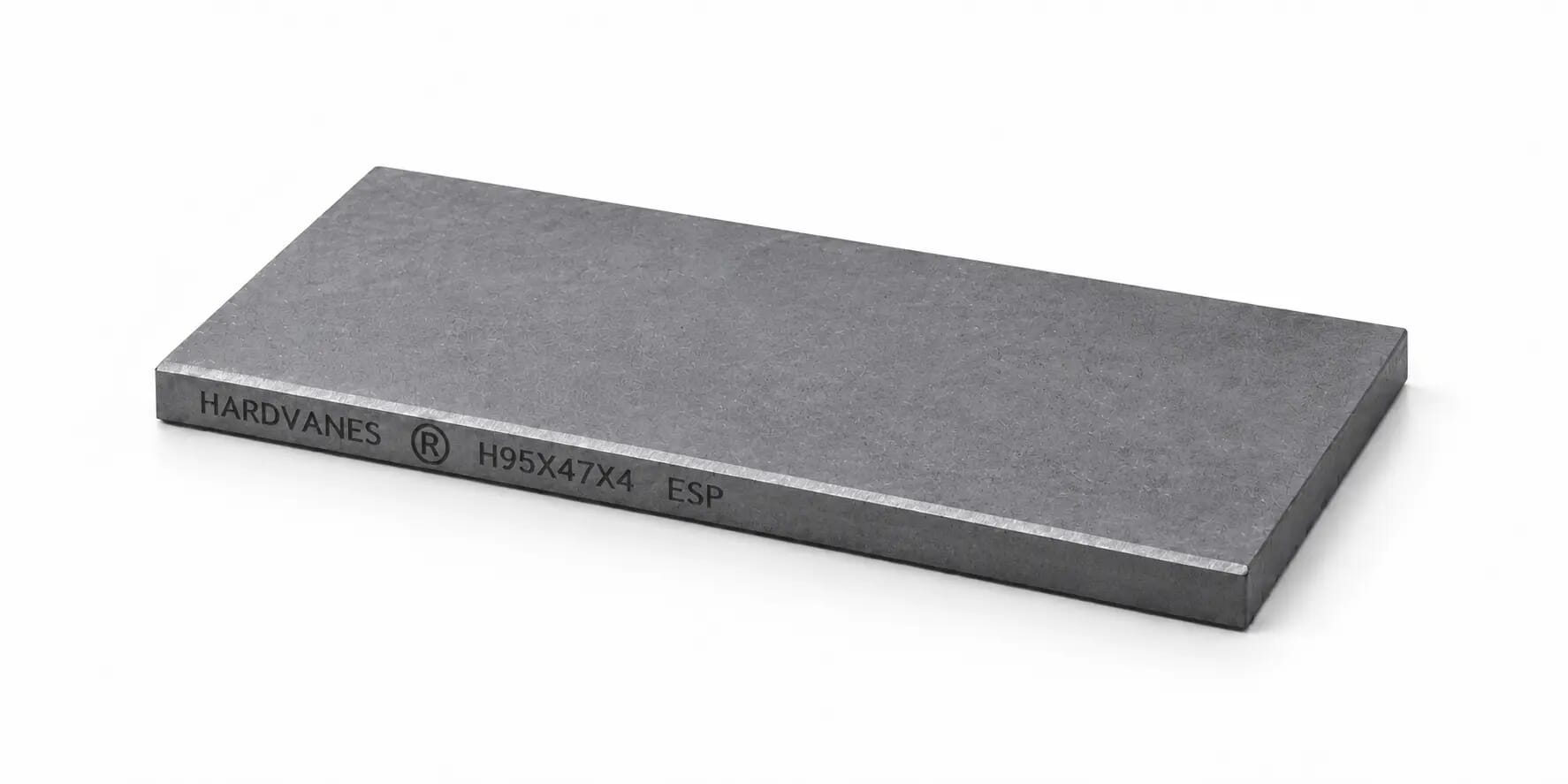
Custom graphite vanes
The same pump family may use different replacements depending on size, version or manufacturing index. At HARDVANES, we assess custom graphite vanes using the available documentation, checking length, height and thickness against the functional details of the part.
The bevel is not decorative. Its orientation, the edge profile and the grooves must correspond to the part design. Manufacturing a vane requires preserving that relationship between geometry, material and application.
From drawing to part
Carbon graphite machining turns the material into a replacement with defined surfaces and dimensions. Milling, dimensional inspection and finishing form one process. Dimensions are checked against the reference rather than inferred solely from a worn part.
If you need replacement vacuum pump vanes but do not have the part number, send us the equipment nameplate and photographs of the set. Prior identification helps avoid orders based only on visual resemblance.
THE MATERIAL.Makes the difference.
Graphite for vacuum: a specific formulation for a demanding function.
Graphite for electrical brushes
An electric motor brush is selected to conduct current and maintain contact with the commutator. Its carbon graphite grade meets those electrical and mechanical conditions.
Machining that material into a vane does not establish its suitability for vacuum use. Matching the replacement’s colour or dimensions is not sufficient either.
Graphite for vacuum pumps
A sliding vane must work in contact with the cylinder, help separate the chambers and withstand loads and temperature. Formulation, sliding behaviour, strength and dimensional stability are selected together.
HARDVANES® EKVAC EVO+ is intended for dry-running vacuum pump and compressor vanes, using German-origin material machined in Spain to suit each part number.
Unsuitable material.
Real risks.
A vane requires carbon graphite specified for that vacuum pump or compressor. Unsuitable material exposes the cylinder and rotor to wear, scoring and internal damage. Formulation, hardness, sliding behaviour and geometry all help protect the assembly.
Internal surfaces
Excessive hardness or abrasive particles promote scoring and wear on the cylinder wall. The vane contacts that surface: its material matters.
Friction and heat
Excessive friction generates heat and accelerates wear. The material and clearances must allow the vane to slide correctly inside the rotor.
Breakage and fragments
Inadequate strength and geometry increase the risk of chipping and breakage. Fragments inside the chamber threaten the rotor and internal surfaces.
Vacuum and production
Excessive wear impairs sealing between chambers and pump performance. A failure means technical intervention, repairs and downtime.
Like an engine lubricant.
An engine needs a lubricant that meets its specification. Selecting carbon graphite for a dry-running vacuum pump demands the same rigour: the vane material itself provides self-lubrication.
A vane that fits and rotates is not proof that its graphite is suitable. Unsuitable material compromises sliding: scoring, wear and internal damage are real consequences of incorrect selection. Choose carbon graphite specified for your pump.
Choose the material your pump needs. Check the part number before installation.
Check my replacement material ↗EKVACEVO+.
Material. Geometry. Finish.
One technical standard.
Carbon graphite vane selection combines material properties with machine design. Copying a dimension is not enough: the way the part works must be understood.
Dry self-lubrication
Graphite facilitates sliding between contact surfaces. In equipment designed for dry operation, the pumping chamber works without an oil supply. This property does not eliminate inspections or normal service wear.
Strength and stability
The vane is subject to mechanical loads and temperature changes. Material selection relates to operating clearances, cooling and machine duty. The permissible temperature is checked for the specific application.
Functional surfaces
Milling, flatness, parallelism and edge finish contribute to the fit. Polishing is defined by the part specification: a shiny surface alone does not establish a tolerance or performance level.
PRECISION.Graphite properties.
HARDVANES® EKVAC EVO+ technical data.
Typical reference-material properties and manufacturing characteristics of our graphite vanes for dry-running vacuum pumps and compressors.
1.73 g/cm³Typical density
80 N/mm²Flexural strength
120 N/mm²Compressive strength
Typical reference-material values. Supply acceptance is confirmed for each vane.
| Characteristic | Value or specification | Meaning |
|---|---|---|
| Material and application | ||
| Material | Special graphite bonded with synthetic resin | Selected for sliding vanes. |
| Application | Dry-running vacuum pumps and compressors | Compatibility depends on the model and part number. |
| Chamber lubrication | Dry operation | No oil supply in equipment designed for this system. |
| Mechanical properties | ||
| Typical density | 1.73 g/cm³ | Reference-material property. |
| Flexural strength | 80 N/mm² | Typical value; not an allowable load for the vane. |
| Compressive strength | 120 N/mm² | Typical material value. |
| Modulus of elasticity | 22,000 N/mm² | Characterises material stiffness. |
| Rockwell hardness | 80 HR 5/100 | Typical value on this test scale. |
| Thermal behaviour | ||
| Thermal conductivity | 6 W/(m·K) | Typical material value. |
| Thermal expansion | 11 × 10⁻⁶ K⁻¹ | Characterisation range: 20–200 °C. |
| Short-term maximum temperature | 180 °C | Not a continuous service limit. Prolonged exposure may change the properties. |
| Geometry and manufacturing | ||
| Dimensions and tolerances | According to the part number or validated drawing | Length, height, thickness, flatness and parallelism. |
| Bevels, grooves and finish | According to the vane design | Machining and finishing adapted to each application. |
| Origin and machining | German-origin graphite · machined in Spain | HARDVANES® EKVAC EVO+ commercial product. |
THE RIGHT FIT.Your machine.
Identical dimensions do not confirm compatibility. These six details provide the starting point for technical selection.
Brand and model
Complete designation, variant and manufacturing index. The equipment nameplate is the starting point for consulting the vane catalogue by brand.
Part number
Replacement code, set number or manual reference. Whether you are looking for a graphite vane or a vacuum pump blade, this code identifies the part beyond its name.
Dimensions
Length, height and thickness in millimetres. A used vane may have lost height compared with its nominal dimension.
Geometry
Bevels, grooves, profile and orientation. Small differences may be functionally significant.
Conditions
Dry or oil-lubricated operation, temperature, operating hours and characteristics of the intake air.
Complete set
Number of vanes and the manufacturer’s replacement criteria. The set is reviewed to avoid unsuitable combinations.
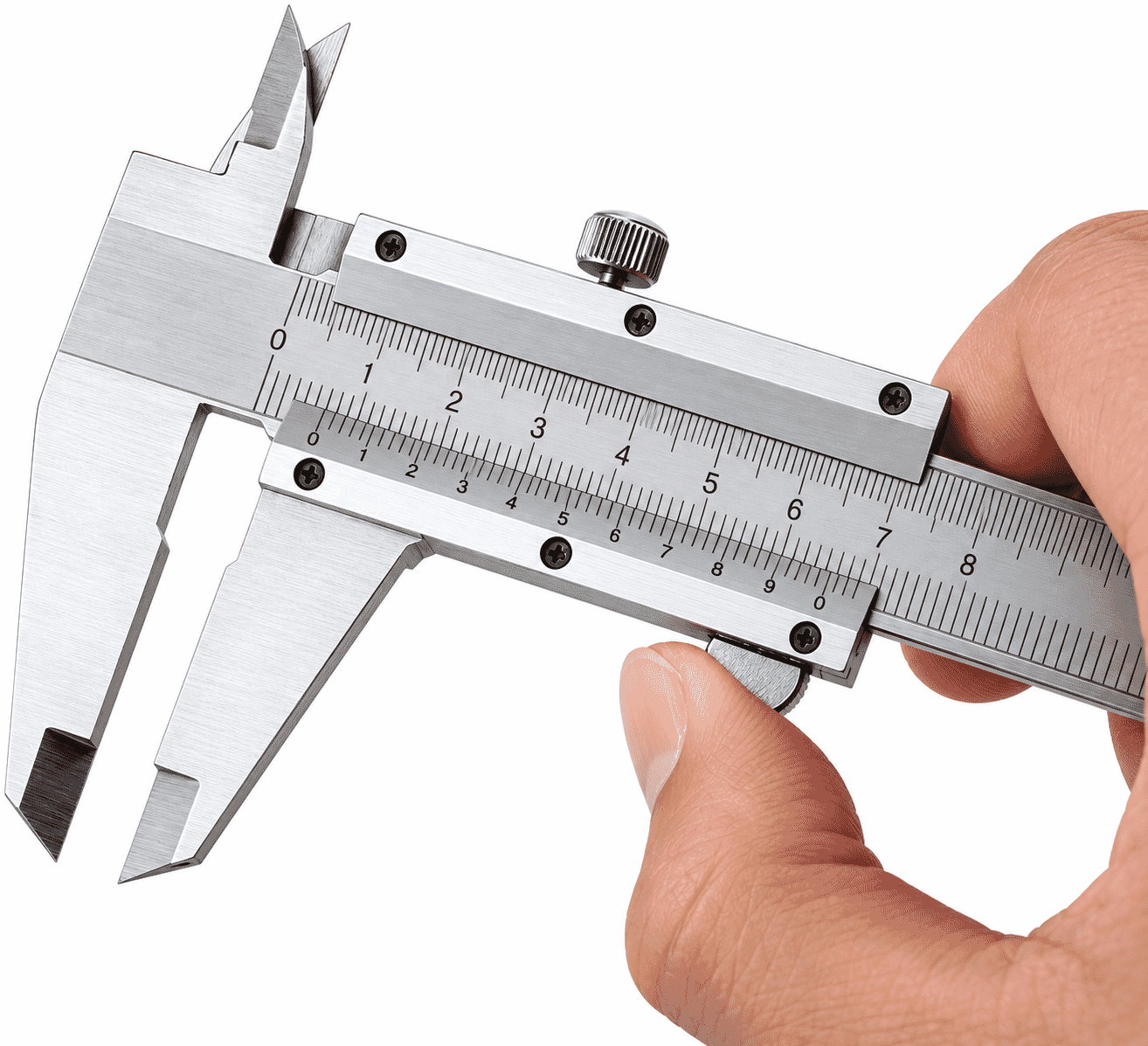
Measure before choosing.
The dimensions of a used vane do not always represent its manufactured dimensions. Check the sample against the reference and document all three dimensions, orientation and number of pieces.
Ask about a dimension ↗TAKE CARE.Keep it turning.
Self-lubrication enables dry operation. Maintenance preserves working conditions.
Wear depends on the equipment, load, filtration and environment. Operating hours alone do not justify a universal service-life promise.
Filtration and cooling
Check dust ingress, filter condition and ventilation according to the manual. Restrictions or poor cooling can alter operating conditions.
Vane wear
Check the minimum permissible height and the condition of every vane. The replacement limit is specific to each model.
Temperature and noise
Investigate changes from normal operation. Do not automatically attribute vacuum loss to the vanes: also check leaks and circuit conditions.
Technical intervention
Stop and isolate the equipment, allow it to cool and follow the manufacturer’s procedure. After breakage, check for fragments and possible damage before restarting.
YOUR INDUSTRY.In motion.
Printing
Paper feeding and transport. Dust filtration is one of the conditions that must be monitored.
Woodworking and CNC
Vacuum clamping. Porosity, leaks and particles influence the system and its maintenance.
Automation
Suction-cup handling. Grip depends on the pump, circuit and process requirements.
Packaging
Moving and positioning packaging. The replacement is selected for the machine, not for the name of the industry.
ANSWERS.Straightforward.
Can electrical brush graphite be used to make vanes?
A vacuum vane needs carbon graphite specified for that application. Selection for electrical contact does not establish suitability for mechanical contact inside a pump. Changing the part’s shape does not change the material formulation. An unsuitable grade exposes the pump to wear, scoring, overheating and breakage. HARDVANES® EKVAC EVO+ is intended for dry-running vacuum pump and compressor vanes.
Why choose application-specific graphite vanes?
The vane works in contact with the pump’s internal surfaces. Its material must meet the application’s sliding, strength, temperature and wear requirements. A visually similar replacement does not demonstrate technical equivalence. HARDVANES® EKVAC EVO+ combines carbon graphite for dry-running vacuum pumps and compressors with machining in Spain and selection by part number.
Are graphite vanes, carbon vanes and carbon blades the same?
In a vacuum pump, graphite vanes, carbon vanes and carbon blades can refer to the sliding parts in the rotor. These names do not establish that two materials are equivalent: the carbon graphite formulation must suit the application. To identify the replacement, check the part number, dimensions, bevels and grooves.
What do carbon vanes and graphite vanes mean?
Carbon vanes and graphite vanes describe vanes made from carbon and graphite materials; vane is singular and vanes is plural. Pump documentation may use vacuum pump vanes. These terms alone do not specify the material grade or compatibility. When selecting HARDVANES® EKVAC EVO+, always check the replacement code and pump model.
What is HARDVANES® EKVAC EVO+?
HARDVANES® EKVAC EVO+ is our carbon graphite vane range for dry-running vacuum pumps and compressors. It combines German-origin material with machining in Spain and part selection matched to each machine.
What does self-lubricating graphite mean?
The vane’s carbon graphite itself provides self-lubrication at the contact surfaces. In a pump designed for dry operation, the chamber works without an oil supply. The material grade must suit that application; self-lubrication does not eliminate wear or maintenance.
Is every carbon graphite suitable for a pump?
No. Carbon graphite covers materials with different formulations and uses. An electric motor brush meets different requirements from a sliding vane. For vacuum use, the material, geometry and service conditions must be checked.
What temperature can my vane withstand?
Service temperature depends on the part number, equipment and operating conditions. Short exposure must be distinguished from continuous operation. Check the pump limit and request information applicable to your vane before setting an operating temperature.
What information is needed to order a replacement?
Send us the pump brand and complete model, vane part number, dimensions and number of pieces in the set. Photographs of the nameplate and replacement help identify variants, bevels and grooves.
Are these original parts from my pump’s manufacturer?
They are HARDVANES-branded replacement parts. Compatibility is checked by part number, geometry and application. The equipment brand identifies the intended machine; it does not make the HARDVANES replacement a part marketed by that manufacturer.
How long does a graphite vane last?
There is no single service life for every machine. Model, duty, dust, temperature and maintenance all influence it. Observe the manufacturer’s minimum height and inspection interval.
Can a vane be manufactured from a sample?
A sample, drawing or part number provides a starting point for assessment. Wear, nominal dimensions, geometry, material and service conditions are checked before manufacturing is confirmed.
Is a mirror finish always better?
The finish is defined by contact requirements and material specifications. Greater shine does not, on its own, demonstrate better performance. Roughness, flatness, parallelism and fit are assessed.
Can these vanes be used in oil-lubricated pumps?
Suitability for dry operation must not be extrapolated to an oil-lubricated pump. The material, lubricant and part number must match the requirements for that model. Check compatibility before installing a vane.
How is a graphite vane measured?
Length, height and thickness are checked with a suitable instrument. Wear may reduce a used vane’s height below its nominal value. Edge profiles, bevels and grooves must also be recorded; a photograph does not replace a drawing when tolerances are required.
Do you manufacture custom graphite vanes?
We assess manufacturing from a part number, drawing or sample. Before confirming supply, we review nominal dimensions, material characteristics, set quantity and intended application. A worn sample is interpreted in light of its condition.
Why does a pump lose vacuum?
Vacuum loss may have several causes: circuit leaks, blocked filters, vane wear or changes in internal clearances. Diagnosis must consider the complete system before attributing the problem solely to the replacement part.
Should I replace the complete set?
Follow the pump manufacturer’s criteria. Check every vane and avoid mixing parts with different geometries, materials or wear levels. Confirm the correct vane quantity for your model before ordering a set.
How can I avoid damaging the edges?
Handle parts carefully and protect them from impacts during storage and installation. Check that the rotor slots are clean and free of burrs. Do not force a vane that will not slide: identify the cause first.
What information can I send by WhatsApp?
You can send a photograph of the pump nameplate, the replacement part number, dimensions and photographs of the faces and edges. Also state whether the equipment runs dry, its approximate operating hours and any signs of wear or abnormal operation.
LET’S TALK.About your next vane.
Brand, model and operating conditions. We start with what your machine needs.