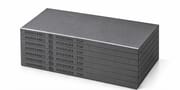
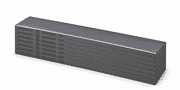
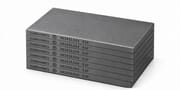
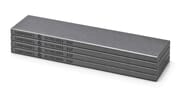
What are vacuum pump vanes?
They are the rectangular parts that slide in the rotor slots of a vacuum pump or rotary vane compressor. As the rotor turns, centrifugal force pushes them against the cylinder, forming the chambers that draw in and compress the air. In dry-running pumps, they are usually made of carbon graphite.
Paleta, aleta, álabe: are they all a vacuum pump vane?
Yes. Depending on the country and the industry, Spanish speakers call the same part a paleta, aspa, pala, álabe or aleta. In English it is a vane: carbon vanes, graphite vanes or carbon graphite vanes, also called rotor vanes, sliding vanes or vacuum pump blades. It is the replacement (spare or wear) part that slides in the rotor slots of rotary vane vacuum pumps and compressors, both dry running (oil-free) and oil-lubricated. At HARDVANES we call them vanes, and they are sold as complete vane sets (vane kits) for each pump model.
How do I know which vanes my pump needs?
From the brand, the full model and the original vane reference, for example the WN reference on Becker pumps. With that information you can search by model or reference in the HARDVANES catalogue. If the pump has no nameplate, send clear photos of the equipment and the vane; sometimes a physical sample is needed.
How do you measure a vacuum pump vane?
With a caliper, in millimetres: the length, from end to end along the rotor axis; the width, from edge to edge (the height of the vane); and the thickness, between the two faces. If the vane is worn, the original width is confirmed using the reference, a sample or the drawing.
I don’t have the vane: can I give you the rotor dimensions?
Yes. The rotor slot length is the vane length, the slot width is its thickness and the slot depth is its width. Also measure the rotor diameter, count the slots and state whether they are radial or inclined. This works for rotors with a shaft, with a hub or short, large-diameter rotors. We check the fit before manufacturing.
Which pump brands do you have vanes for?
For Becker, Busch, Rietschle, Orion, DVP, Heidelberg, Gast, Duravane, Republic and Schmalz, with 176 sets in the HARDVANES catalogue. You can search by brand, model, original reference, HARDVANES reference or dimensions; if your reference isn’t listed, we look into custom manufacturing.
Which industries use HARDVANES vanes?
In the main vacuum industries, with customers in 43 countries: printing, graphic arts, the woodworking industry, food and packaging, laboratories, robotics, the plastics industry, construction and electronics. Wherever a vacuum pump or rotary vane compressor is at work, the vane is chosen by the pump’s brand and model, its dimensions and the right material for the application.
Are HARDVANES vanes compatible with the original vanes?
Yes: they are high-performance vanes, 100% compatible with the originals for each reference. Compatibility is confirmed by pump model, dimensions, material and number of vanes in the set.
When should the vanes be replaced?
When they reach the wear limit given in your model’s manual or show damage such as cracks or chipping. Wear is measured as loss of height (H), between the two long edges. There is no minimum height or service life in hours that applies to all pumps.
Why does a vane break prematurely?
Possible causes include incorrect installation, contamination, mechanical wear, blockages or a material unsuitable for the equipment. Stop the pump and inspect the whole assembly before fitting new vanes; keep the fragments and note the hours since the last change, the material installed and the condition of the filters.
Why is my pump losing vacuum?
It may be due to vane wear, leaks, clogged filters or contamination. Inspect the whole assembly according to the manual before deciding which parts to replace, and compare like-for-like measurements: a reading at the process and another at the pump may describe different situations.
Which way does the vane bevel face?
It depends on the model: the bevel position must be checked in the manual for the pump and for the specific reference. It should not be inferred from the logo, the colour, a photo of another pump or a general rule about the direction of rotation.
Should graphite vanes be lubricated?
No. In dry-running pumps, no oil or grease is added to the carbon graphite vanes or to the chamber. Bearings may have different maintenance requirements: see the manual.
Which material should I choose: carbon graphite, G11++ or Kevlar?
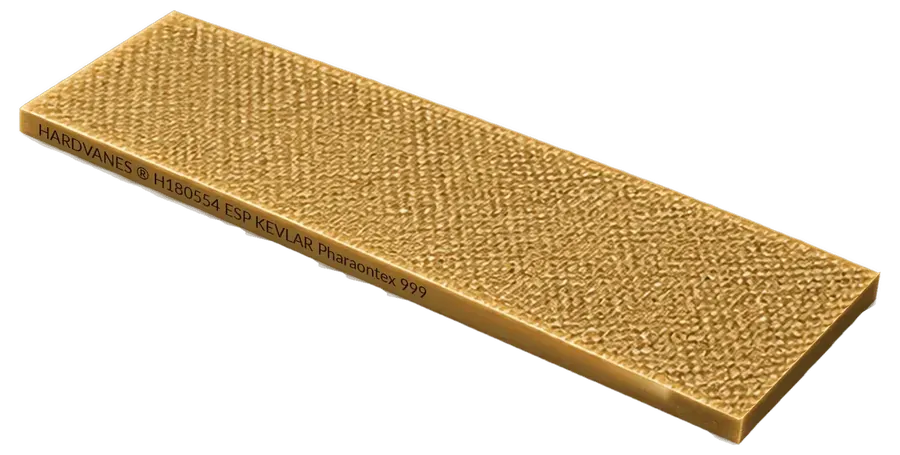
The one your equipment specifies. The choice depends on the pump design, dry-running or lubricated operation, temperature, load and the intended reference. Materials should not be swapped just because the dimensions match.
What are the properties of EKVAC EVO+ carbon graphite?
It is the carbon graphite used in HARDVANES vanes: flexural strength of 80 MPa and compressive strength of 120 MPa, Young’s modulus of 22 GPa, Rockwell hardness of 80 HR5/100, density of 1.73 g/cm³ with no open porosity, thermal conductivity of 6 W/(m·K), thermal expansion of 11 × 10⁻⁶ K⁻¹ (20–200 °C) and a maximum temperature of 180 °C for short-term exposure.
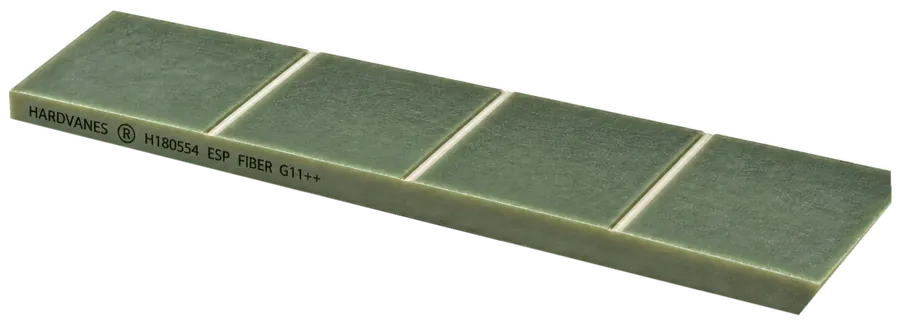
What temperature can G11++ epoxy fibre vanes withstand?
Up to 220 °C. Even so, the vane material must be the one your equipment specifies according to its design, operating temperature and load.
What are the properties of the G11++ epoxy fibre used in HARDVANES vanes?
It is a G-11/220 type glass fabric and epoxy resin laminate: flexural strength of 340 MPa, flexural modulus of 24 GPa, tensile strength of 300 MPa, compressive strength of 350 MPa and impact strength (Charpy) of 33 kJ/m², density of 1.7–2.0 g/cm³ and a temperature index of 220 °C. These are reference values for the laminate; the material and application are reviewed case by case.
How do I identify a HARDVANES vane?
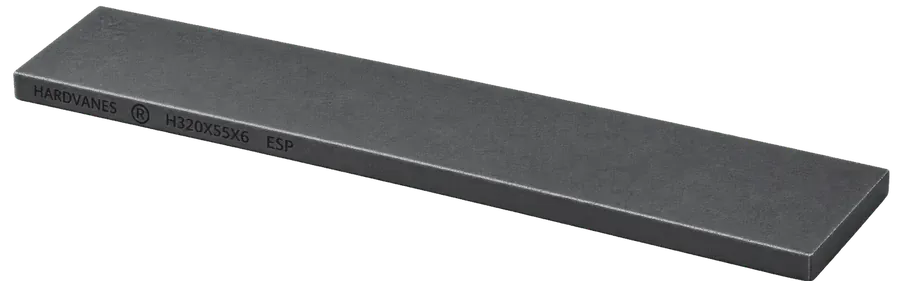
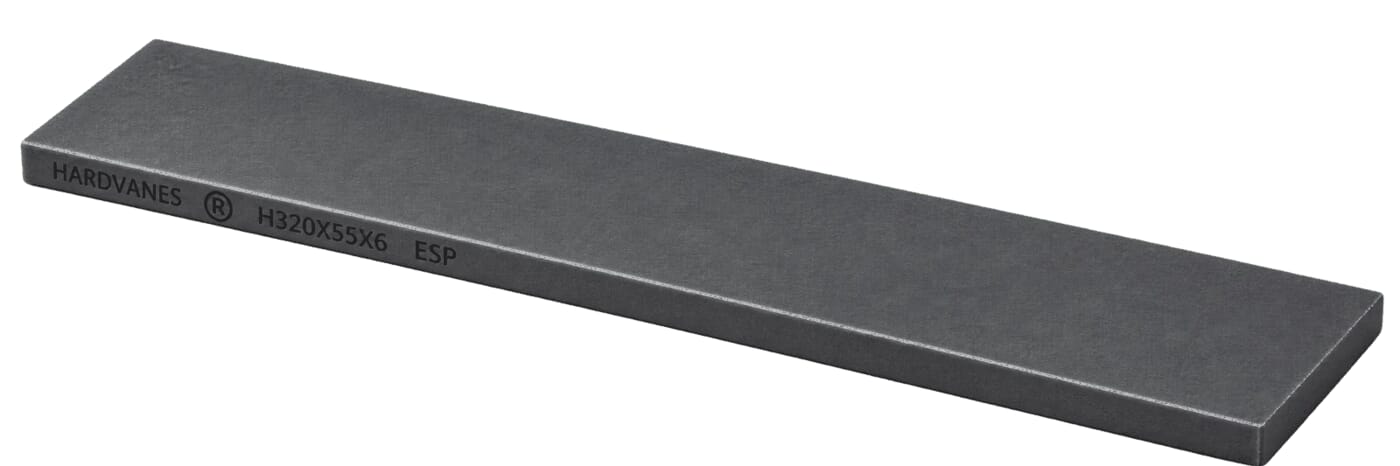
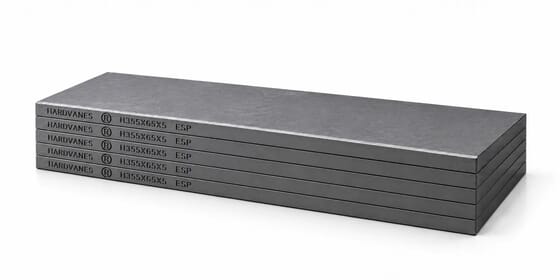
By the laser engraving on the edge opposite the bevel: the HARDVANES® brand, the vane reference (for example, H320X55X6), ESP for “fabricada en España” (made in Spain) and HIGH PERFORMANCE. It is engraved in the final stage, once the part has been measured and approved.
Where are HARDVANES vanes made?
In Spain. Machining (cutting, grinding, milling and polishing) is done in Barcelona; for EKVAC EVO+ carbon graphite vanes, the material comes from Germany. They are shipped from Barcelona to customers in 43 countries.
How is each vane checked before shipping?
With a digital caliper, once machining is finished: the length, plus the width and thickness at three sections of the part. Only vanes that meet their dimensions move on to laser engraving and packing.
Do you make custom vanes?
Yes. We make custom vanes from 4 units, from a sample, a drawing, a CAD file or the part’s dimensions. In carbon graphite, up to 400 mm long and 8 mm thick; above those sizes, get in touch. Before manufacturing, we review the material, geometry and feasibility. Machining is done in Barcelona.
Is there a minimum order?
For custom manufacturing, the minimum order is 4 units. For catalogue references, each product page states what the set includes; check availability if you need several units.
Can I replace just one vane in the set?
Follow the manufacturer’s instructions. If it requires replacing the complete set, do not mix new and used vanes: they may wear or behave differently.
How many vanes are in a vane set (kit)?
As many as the rotor of your pump model needs: the number varies from one model to another. Each product page states how many units the sales reference includes; compare it with the number of rotor slots before buying.
What should I do if my reference has been discontinued?
Send us the sample or drawing and the equipment details. Based on that information, we will look into custom manufacturing.
Do you ship outside Spain?
Yes. HARDVANES has customers in 43 countries and ships from Gavà (Barcelona): with GLS to Spain and Portugal, and with DHL Express to all other countries. Availability and lead time depend on the reference and the destination.
What payment methods do you accept?
Mastercard cards, bank transfer, PayPal and Wise.